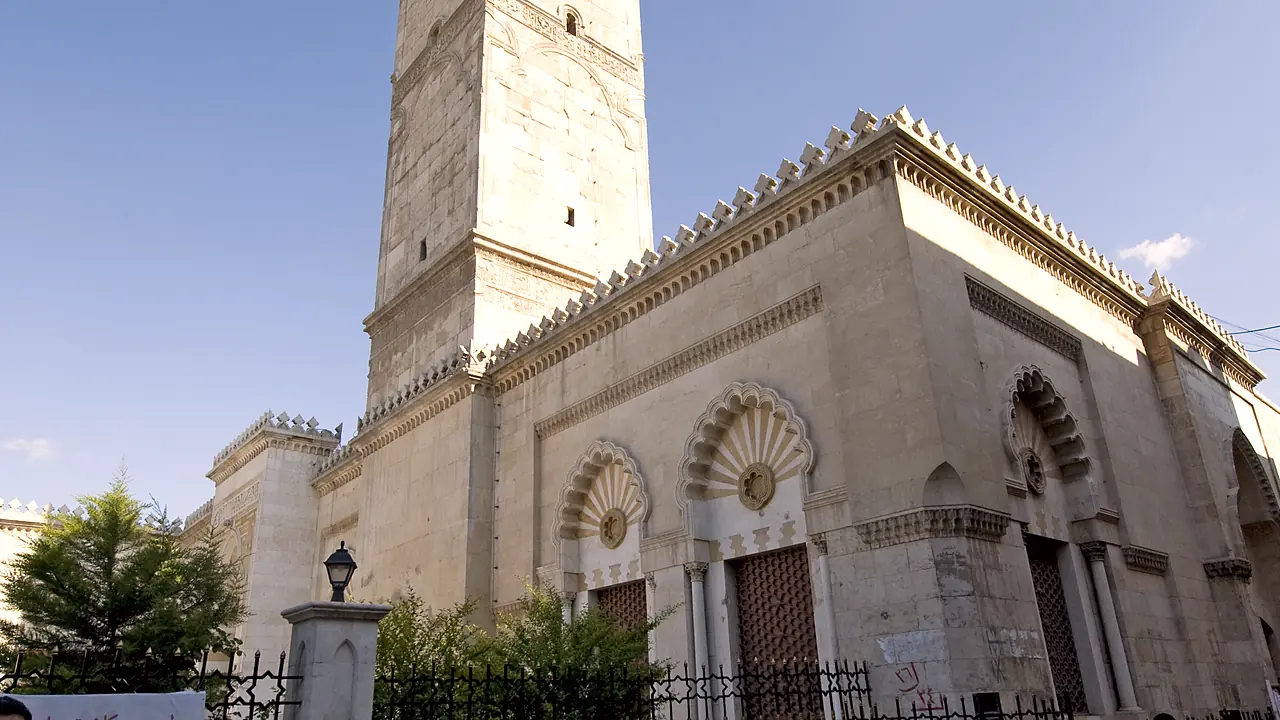
01The courtyard
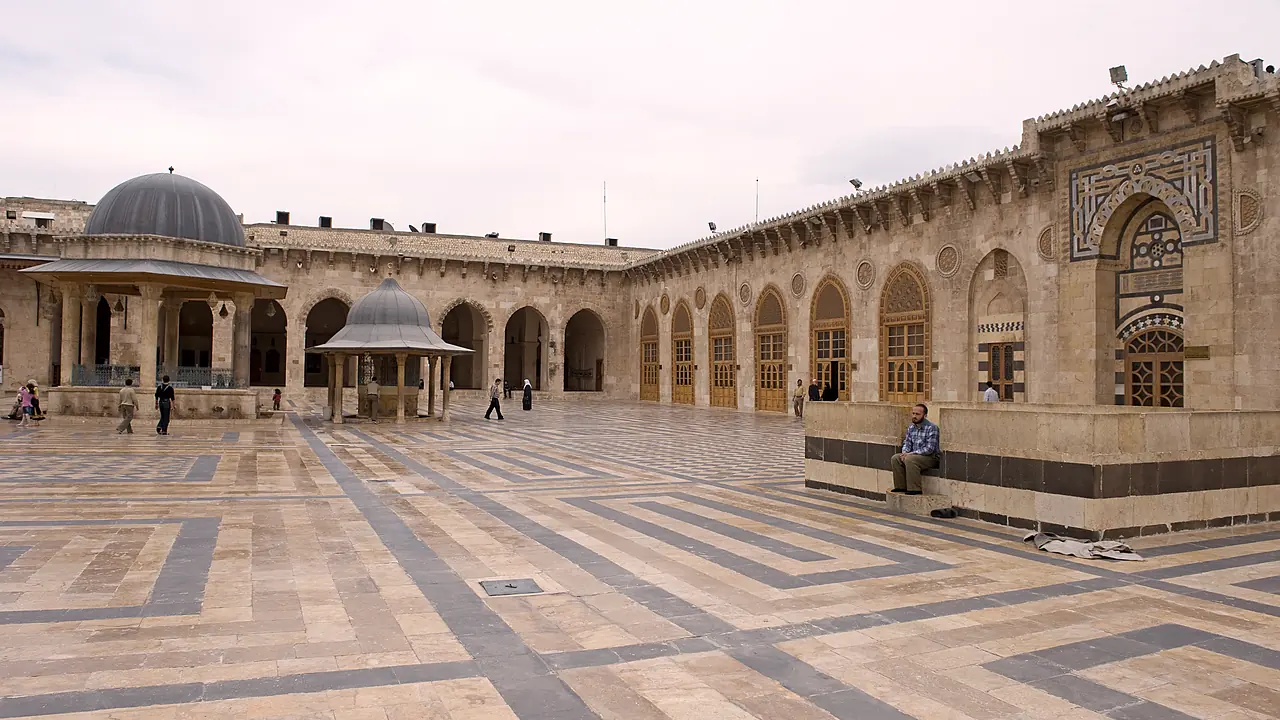
The first thing the mosque opens onto is its courtyard, and it is the finest thing in it. The floor is laid in alternating black and white stone worked into geometric arrangements, with arcades around the sides. It holds two roofed ablution fountains, an open platform for prayer, and a sundial.
The sundial is worth stopping at. A solar clock in a mosque courtyard, from which the times of prayer are read off the shadow of a gnomon: this was the answer before it became a table on a screen.
The mosque as a whole is a rectangle of roughly a hundred and fifty metres by a hundred, with the courtyard at its centre.
02The prayer hall
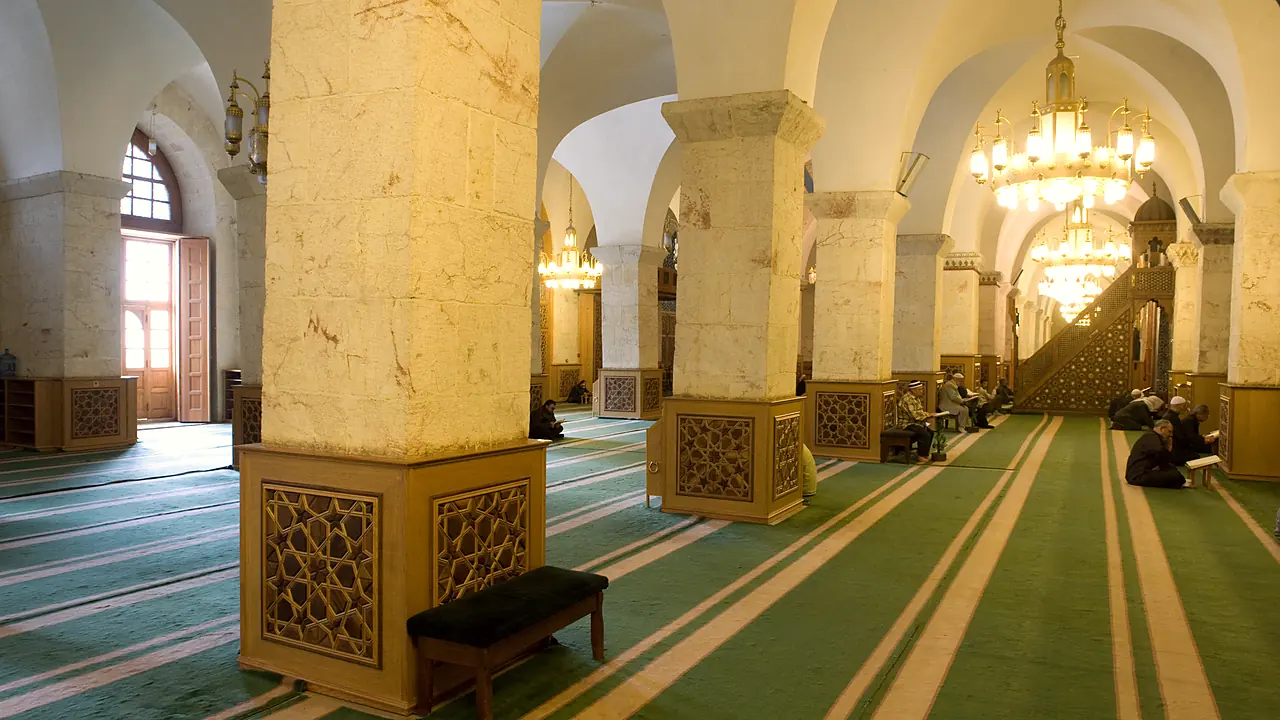
It stands on the southern, qibla side: three aisles carried on eighteen square piers with cross-vaults. Its roof was originally simpler, with a dome at the centre, and was redesigned under the Mamluks into the cross-vaulted system you see today.
The other sides are arcades — two aisles each on the east and north, one on the west.
03The mihrab
Deep, round, and richly carved. The earlier mihrab burned, and Sultan Qalawun replaced it in 1285.
04The minbar
The prayer hall holds a minbar of the fifteenth century.
The history of this mosque's minbars is tangled: sources record a minbar carried off in 1281 after the Mongol invasion, and others attribute a minbar to Sultan al-Nasir Muhammad (1293–1341).
05The maqam of Zakariyya
Inside the prayer hall is a square domed chamber, raised a single step above the floor and faced in Kashan tile. It holds the shrine associated with the prophet Zechariah — Zakariyya, father of John the Baptist.
The attribution rests on an account from 1120. Workmen in the mosque found a marble box, closed and sealed with lead, inscribed: “This is one of the organs of Zakariyya the Prophet.” From that report the place became a shrine, and it acquired visitors, and they have not stopped coming in nine hundred years.
It should not be confused with the shrine of John in the Umayyad Mosque of Damascus: this one is the father, that one the son.
The shrine carried a covering embroidered in silver with Qur’anic verses, and among its treasures was a box said to hold a hair of the Prophet. Its contents were looted in 2013.
06The gates and the inscriptions
Writing in this mosque is a record, not ornament: from the minaret alone came the date of the building, the name of the man who ordered it, and the name of its architect.
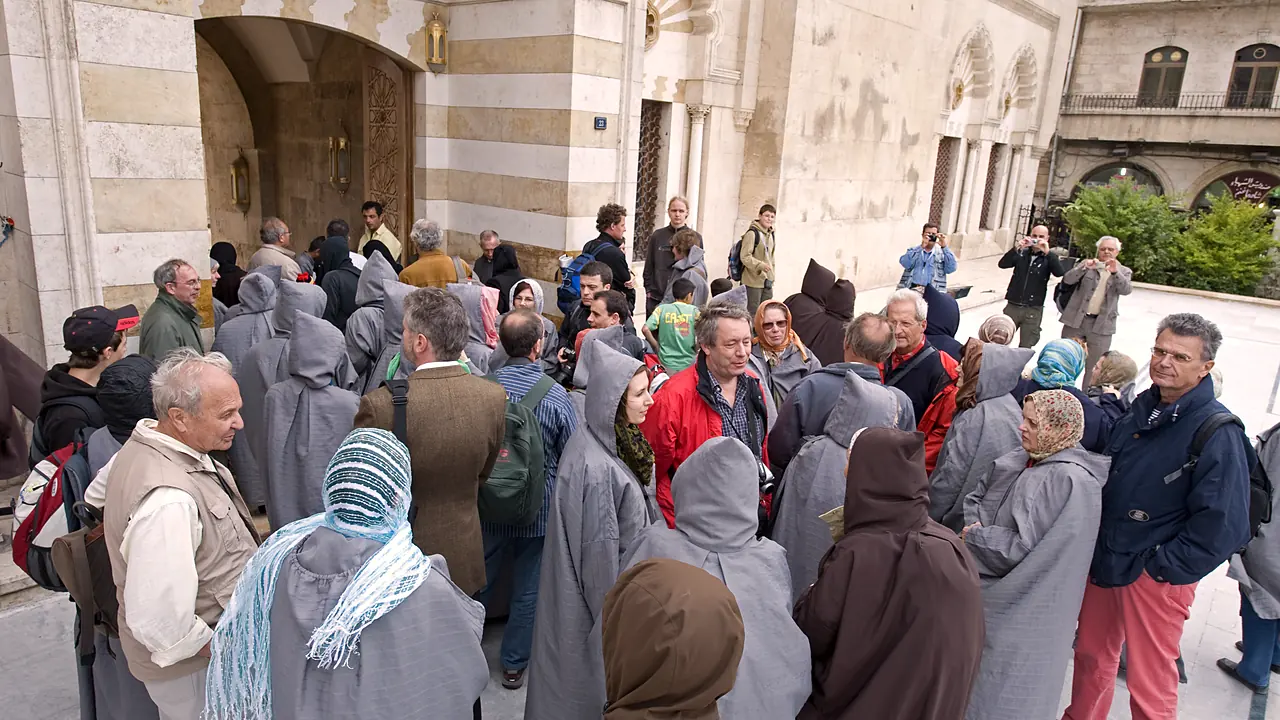
And on the central entrance there is an inscription attributing its construction to the Ottoman sultan Murad III — while the entrance itself is Mamluk work. That is worth saying plainly: stone preserves, but sometimes it preserves a mistake. Which is a good reason to read what is written on a building rather than simply believe it.