01A stone that says it was renewed
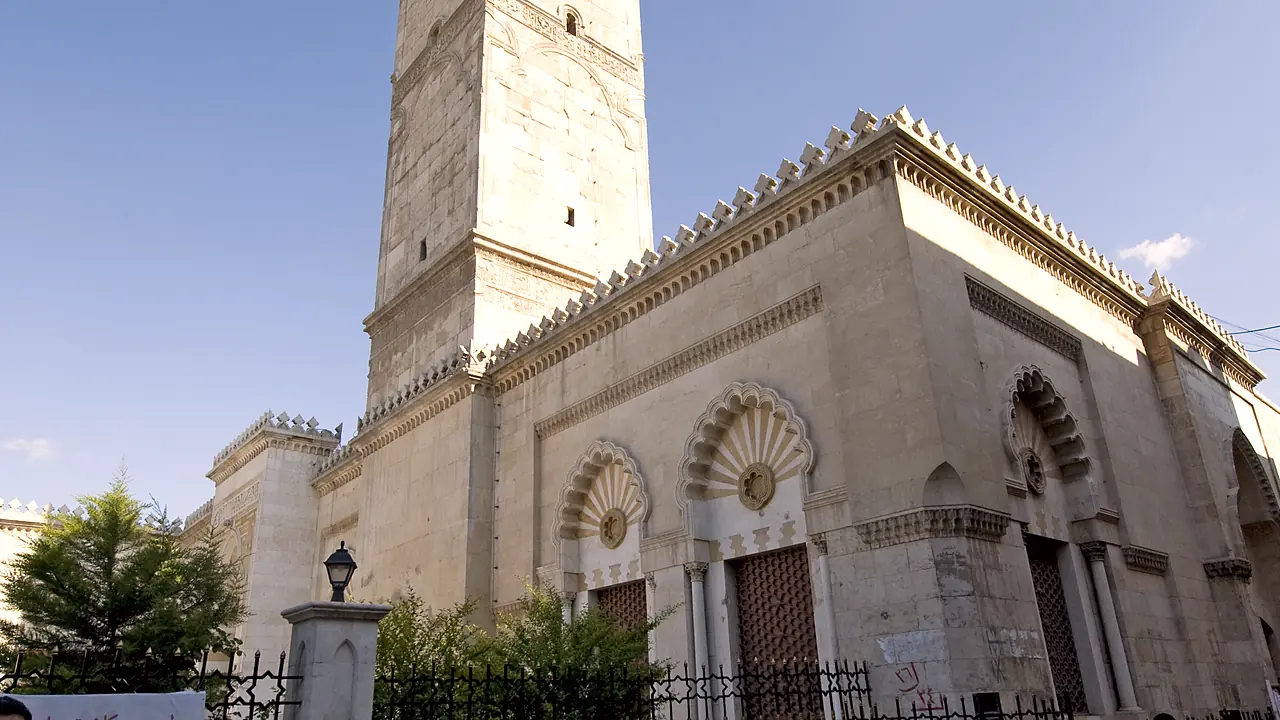
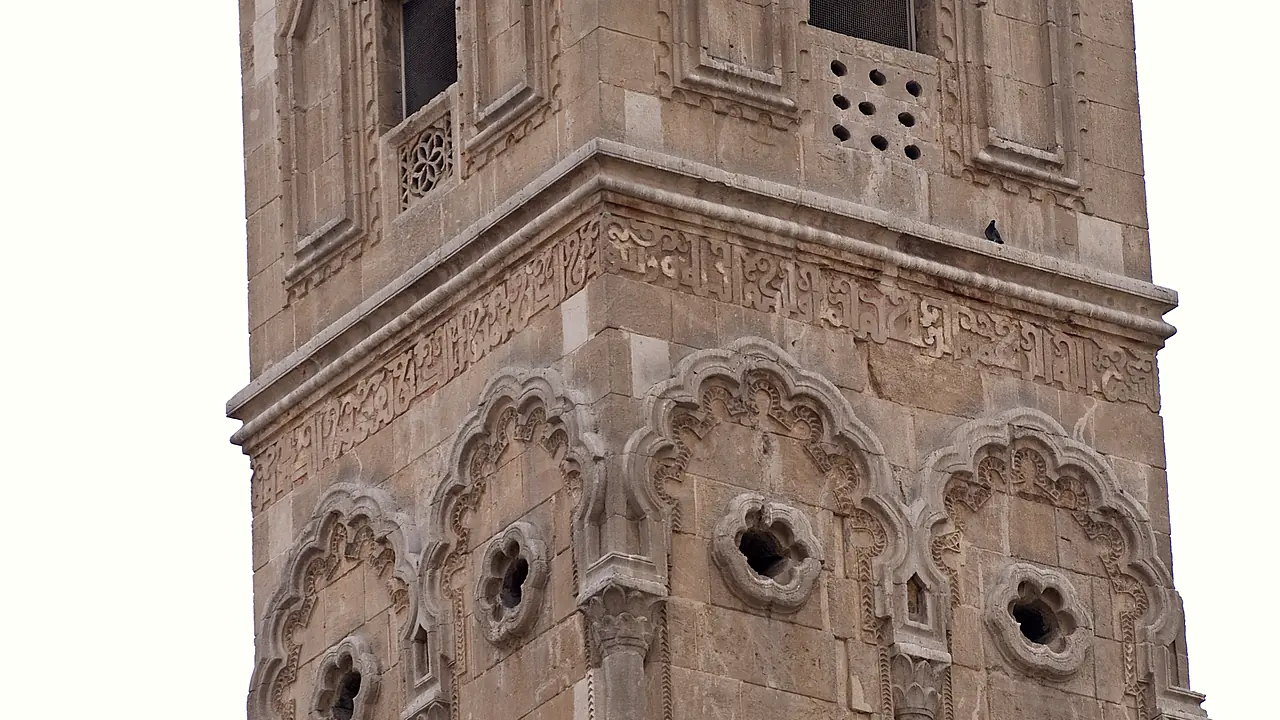
A band of Kufic inscription around the shaft records that the structure was renewed — juddidat — in 483 AH, 1090 CE. The word is deliberate. The stone does not say the minaret was built; it says it was renewed. Something stood here before, and we do not know enough about it.
That is the first thing worth saying on a page about a minaret that fell: this mosque has raised its tower before, and is raising it again. What is happening now is not unprecedented for this building.
02Who ordered it, and who built it
- Dates
- Begun 483 AH / 1090 CE, completed 487 AH / 1094 CE
- Commissioned by
- The qadi of Aleppo, Muhammad ibn Yahya ibn al-Khashshab
- Architect
- Hasan ibn Mufarraj al-Sarmani — named on the building itself
- Completed under
- Tutush, Abu Sa'id Taj al-Dawla
- Height
- 45 metres
- Storeys
- Six
- Steps
- About 174
It is rare to know the name of an eleventh-century architect. Hasan ibn Mufarraj al-Sarmani's name survives because it was cut into the building, so it lasted as long as the minaret did — and when the minaret came down, the name stayed in the stone that was gathered from the rubble.
03Why it was held to be among the finest
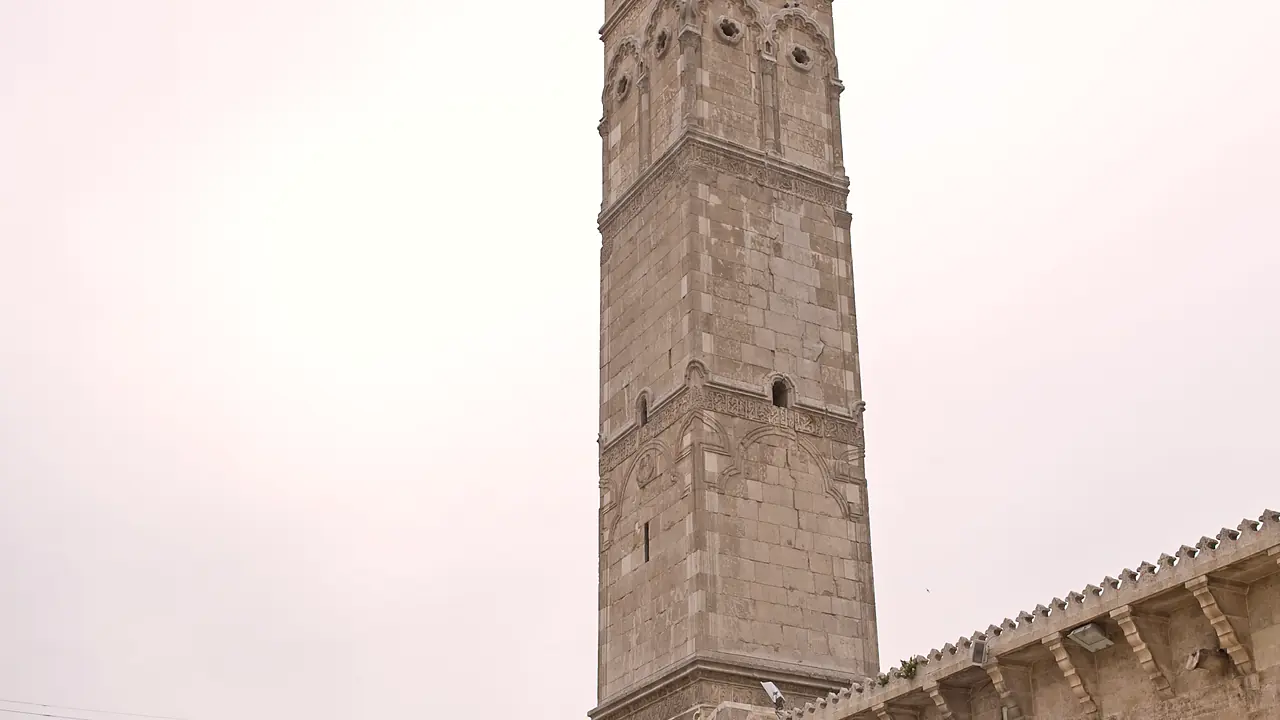
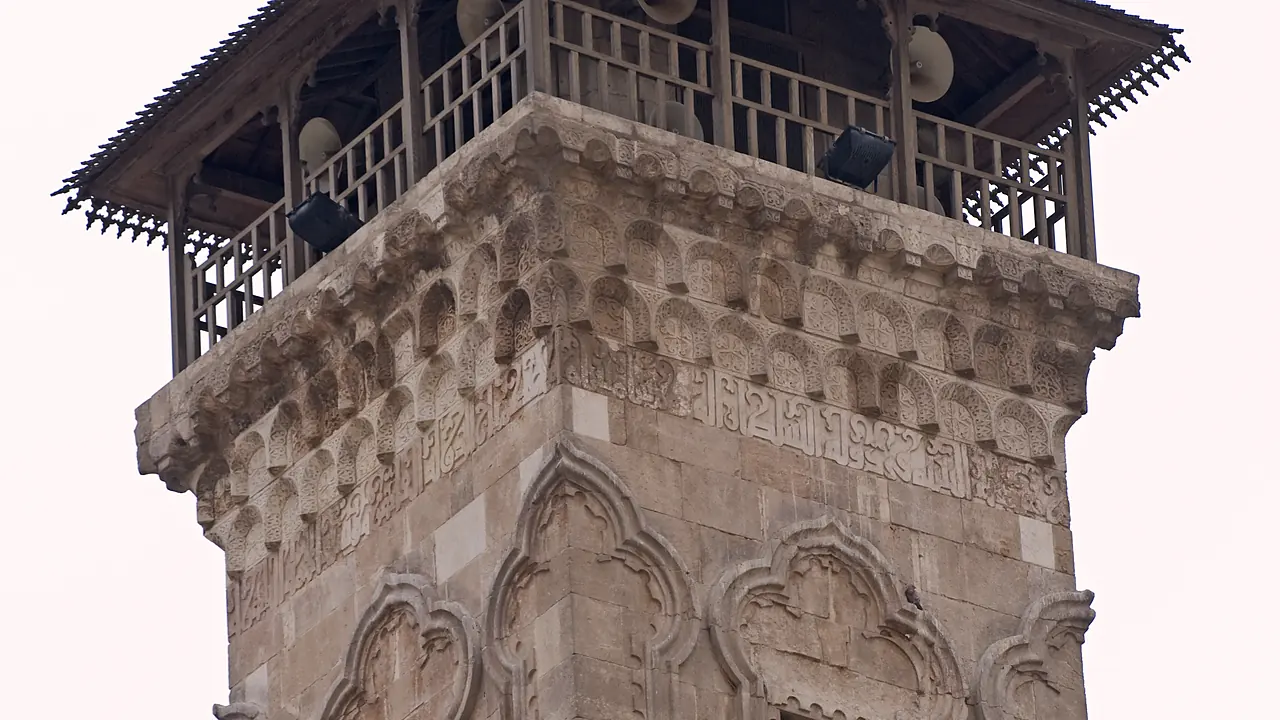
Because the shaft is not a plain tower with ornament applied to it. The whole elevation is organised in bands: inscription, then ornament, then muqarnas, then inscription again — the stone rises and the reading rises with it. The script is Kufic lower down and admits Naskhi higher up, so a single elevation lets you read a century of change in Arabic letterforms.
It stands at the north-west corner of the courtyard, detached from the mass of the mosque, which is why it was visible from the souks and the lanes of the Old City before the mosque itself was. It was, literally, the first thing you saw of Aleppo.
04April 2013
In April 2013 the minaret fell. The shaft broke into roughly two thousand pieces of stone, across the courtyard and around it.
This page records what was lost, when, and in what condition. It does not attribute the cause. The accounts conflict, the site is published under the authority of official bodies, and adjudicating a dispute is not its job. Here the stone is the only witness.
05The accident that made rebuilding possible
In 2010 — three years before the collapse — Gabriele Fangi, professor of photogrammetry at Marche Polytechnic University in Ancona, carried out a complete photogrammetric survey of the minaret. He had no reason to do it beyond its being his work.
In 2018 he gave his high-resolution imagery to the Syrian team. Which means the minaret is fully measured: its heights, the dimensions of its courses, the positions of its bands — fixed in photographs taken in the last years it stood.
So what is under way is not a guess at a lost shape. It is the reassembly of something that was recorded.
06How it is going back up
The stones were recovered from the rubble and sorted. Each is weighed, measured, and tested with ultrasound to establish whether it is still sound inside, then photographed from several angles so that photogrammetry can return it to its original position in the shaft.
The sound stones are re-dressed and reused. The foundations have been exposed and rebuilt, and the tower has risen as far as the level of the spiral staircase — in the minaret's own stone.
No completion date has been announced. Everything on this page is written in the present tense because the work is present.
07And there is an argument worth stating
Rebuilding a lost monument “as it was” is contested among conservation professionals — not only in Aleppo, but at every heritage site a war has reached.
One position holds that rebuilding is an obligation: the minaret is part of a city's identity and its memory, the stones exist, the measurements exist, and leaving it as rubble is a punishment that goes on being served by the people of the place rather than by whoever brought it down.
The other holds that the ruin is testimony: to return a monument to apparent wholeness is to erase from its surface the record of what happened to it, and what finally stands is a new building made of old stone, not the building that fell.
This site does not settle the question. It takes the view that anyone standing beneath the minaret is entitled to know the question is there, and that it is open.